Java

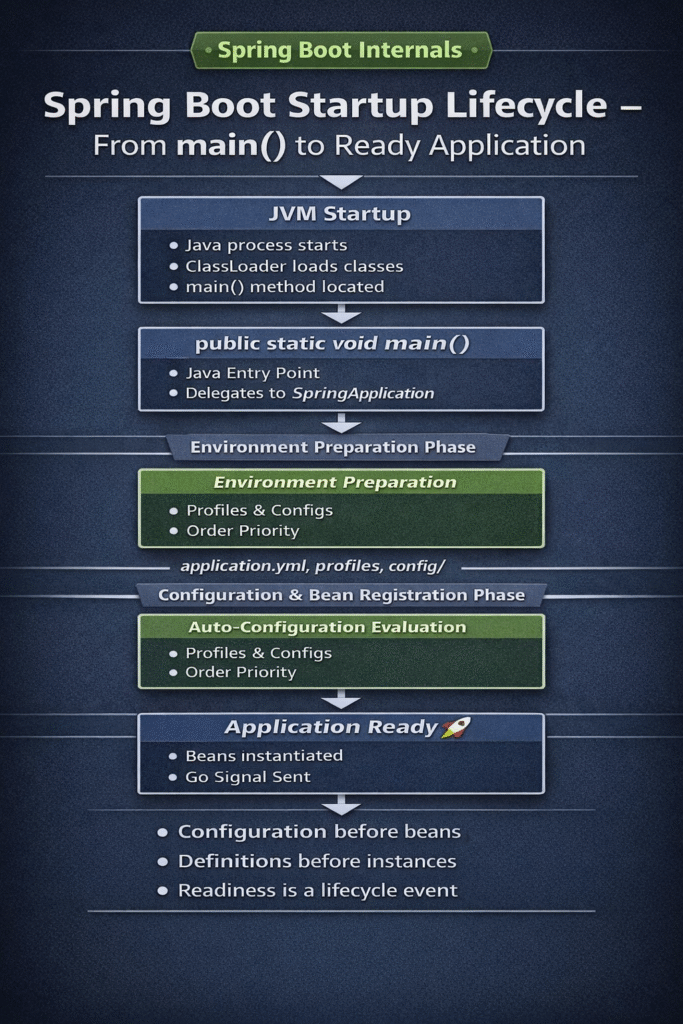
Spring Boot startup lifecycle showing the flow from main() method through SpringApplication.run(), environment preparation, application context creation, bean initialization, and application ready state

Spring Boot Startup Lifecycle — From main() to a Ready Application

Spring Boot is one of the most widely used frameworks in modern Java backend systems. Most developers use it daily, yet very few truly understand what actually happens when a Spring Boot application starts. This article explains the Spring Boot Startup Lifecycle in detail, from the JVM invoking main() to a fully ready application. In […]

Spring Boot Startup Lifecycle — From main() to a Ready Application Read More »
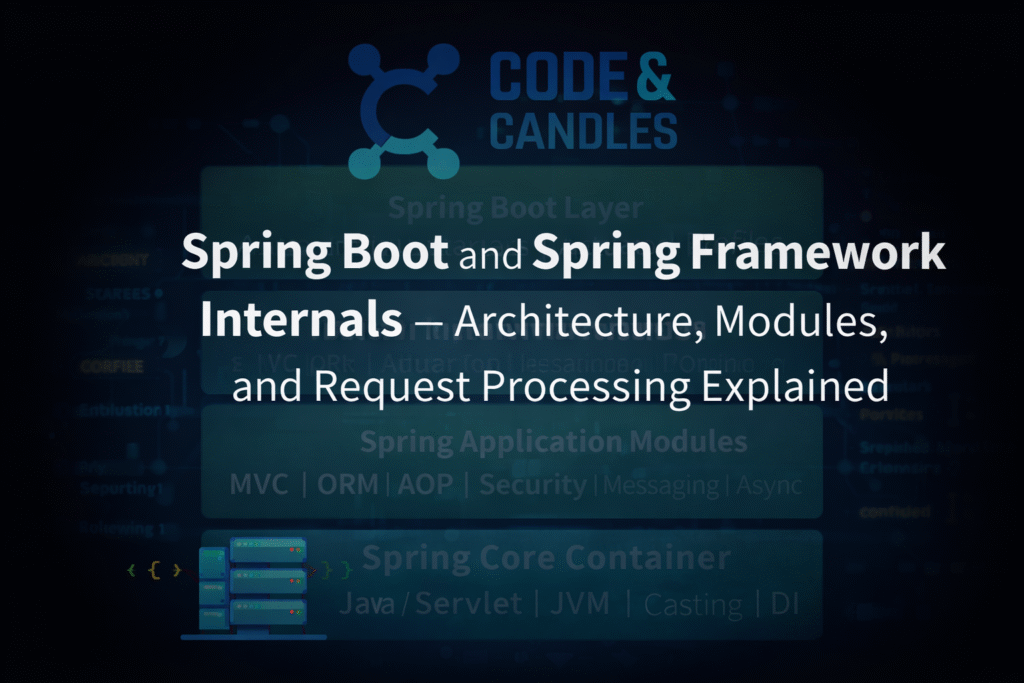
Spring Boot and Spring Framework internals feature image showing layered architecture, core modules, and HTTP request processing flow.

Spring Boot and Spring Framework Internals — Architecture, Modules, and Request Processing Explained

Spring is one of the most widely used ecosystems for building enterprise Java applications, yet many developers use Spring Boot daily without fully understanding how Spring actually works under the hood. Spring Framework is a foundational Java framework that provides inversion of control (IoC), dependency injection (DI), transaction management, and infrastructure support for enterprise systems.Spring

Spring Boot and Spring Framework Internals — Architecture, Modules, and Request Processing Explained Read More »

REST API Performance Optimization: Concepts, Tradeoffs, and Best Practices

REST APIs are the backbone of modern distributed systems. Whether powering mobile apps, web frontends, or microservices, their performance directly impacts latency, throughput, scalability, and overall system reliability. REST API performance optimization requires analyzing every layer in the request lifecycle—client, network, server, application logic, and data access—to reduce bottlenecks and improve p95/p99 tail latency. This

REST API Performance Optimization: Concepts, Tradeoffs, and Best Practices Read More »

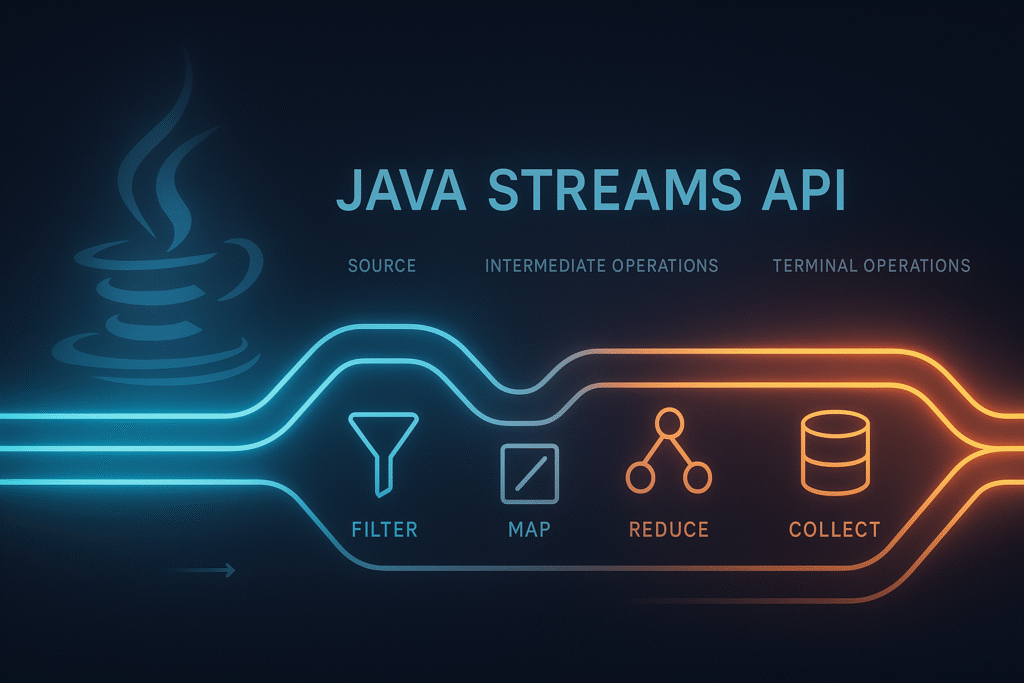
Java Streams API Explained — A Complete Beginner-Friendly Guide to Stream Pipelines, Lazy Evaluation, and Functional Operations

The Streams API is one of the most powerful features introduced in Java 8. It brings functional-style data processing to Java, allowing you to write cleaner, more expressive, and more maintainable code. With Streams, you can filter, transform, and process data using a fluent, declarative style that removes the need for loops, temporary variables, and

Java Streams API Explained — A Complete Beginner-Friendly Guide to Stream Pipelines, Lazy Evaluation, and Functional Operations Read More »

A Complete Beginner-Friendly Guide to Lambda Expressions, Functional Interfaces & Optional in Java 8

Java 8 Lambda Expressions introduced some of the most important improvements in modern Java—Lambda Expressions, Functional Interfaces, Streams, Method References, and Optional. Together, these Java 8 Lambda features reshape how we write code by making it cleaner, more expressive, and far less verbose. These features bring functional programming capabilities to Java while still preserving its

A Complete Beginner-Friendly Guide to Lambda Expressions, Functional Interfaces & Optional in Java 8 Read More »

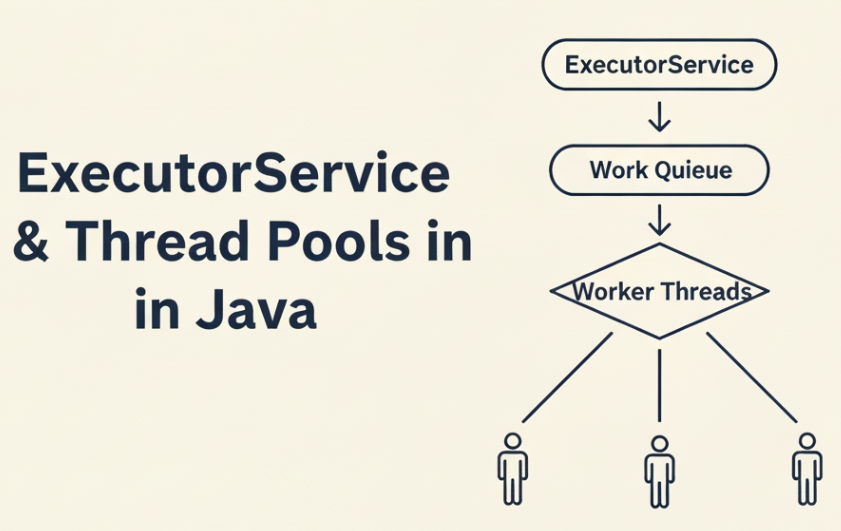
executorservice and thread pools in java architecture diagram

ExecutorService & Thread Pools in Java: Concepts, Tradeoffs, and Best Practices

A comprehensive exploration of thread pools, task execution, concurrency internals, and performance engineering in the JVM. Understanding concurrency is one of the most significant upgrades in a Java developer’s career.ExecutorService is where real-world Java concurrency begins. Modern Java applications—backend services, distributed systems, real-time data processors—depend heavily on controlled, predictable, and efficient concurrency. Poor concurrency decisions

ExecutorService & Thread Pools in Java: Concepts, Tradeoffs, and Best Practices Read More »

Java Concurrency Interview Questions — 20+ Essential Q&As (With Short, Clean Answers)

Java concurrency questions show up in almost every backend interview.The goal of this guide is simple: give you short, clean explanations you can say out loud at a whiteboard — without drowning in theory. This article assumes you’ve already read the basics from:👉 Concurrency in Java — A Complete Beginner-Friendly Guide Here, we focus only

Java Concurrency Interview Questions — 20+ Essential Q&As (With Short, Clean Answers) Read More »

Concurrency in Java — A Complete Beginner-Friendly Guide

Learn how Java handles concurrency using Threads, Runnable, and Callable, and build a strong foundation for backend interviews. 🔹 What is Concurrency? Concurrency in Java refers to the ability of an application to execute multiple tasks at the same time (or appear to). It improves: 🔹 Concurrency vs Parallelism Many people confuse the two: Concept

Concurrency in Java — A Complete Beginner-Friendly Guide Read More »