
Java 8 Lambda Expressions introduced some of the most important improvements in modern Java—Lambda Expressions, Functional Interfaces, Streams, Method References, and Optional. Together, these Java 8 Lambda features reshape how we write code by making it cleaner, more expressive, and far less verbose.
These features bring functional programming capabilities to Java while still preserving its familiar object-oriented foundation. They reduce boilerplate, improve readability, and make everyday coding tasks faster and safer.
In this beginner-friendly guide to Java 8 Lambda Expressions, you’ll learn exactly how these features work through clear explanations, practical examples, best practices, and common pitfalls you’ll want to avoid.
1. What Is a Lambda Expression in Java 8?
Lambda Expressions introduce the ability to treat code as data, meaning you can pass behavior into methods just like values. Lambdas make your code more concise, readable, and expressive — especially when working with Streams or Collections.
🔹 Key Characteristics of Lambda Expressions
- Represent a block of code that can be passed like an object
- Provide concise alternatives to anonymous inner classes
- Enable functional programming in Java
- Reduce verbosity and improve readability
- Work only with Functional Interfaces
Basic Syntax Pattern
A lambda expression has three parts, each serving a clear purpose:
- Parameters — The inputs for the lambda; similar to method parameters.
- Arrow Operator (
->) — Separates parameters from the lambda body. - Expression / Body — The logic to execute; can be a single expression or a block.
✔ Syntax Form
(parameters) -> expression
(parameters) -> { statements }
✔ Examples
| Scenario | Example |
|---|---|
| No parameters | () -> System.out.println("Hello") |
| One parameter | name -> name.toUpperCase() |
| Two parameters | (a, b) -> a + b |
| With block | (int x, int y) -> { int sum = x + y; return sum; } |
2. What Is a Functional Interface?
A Functional Interface is an interface with exactly one abstract method. Lambda expressions rely on these interfaces because they provide the “target type” for the lambda implementation.
🔹 Why Functional Interfaces Matter
- Define the behavior that the lambda will implement
- Enable functional programming constructs
- Form the backbone of the Stream API
- Allow Java to infer lambda parameter types and return types
- The compiler validates them using the
@FunctionalInterfaceannotation
🔹 Characteristics of Functional Interfaces
- Exactly one abstract method (SAM: Single Abstract Method)
- Can have any number of default or static methods
- Optional
@FunctionalInterfaceannotation ensures compiler safety - Used heavily in Streams, Collections, and concurrency APIs
3. Four Essential Functional Interfaces in Java 8
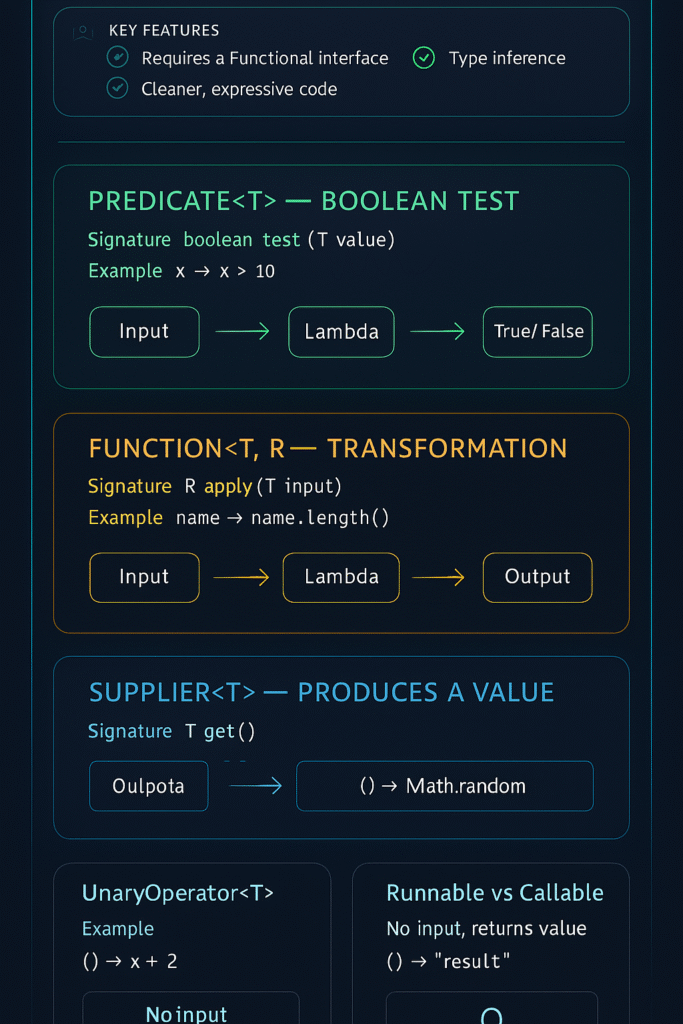
Java 8 introduced a powerful set of built-in functional interfaces in the java.util.function package. These represent the core operations used across Streams and Collections.
1️⃣ Predicate<T>
Predicate represents a boolean test on a value.
✔ Usage
- Used for filtering
- Common in
.filter()stream operations
✔ Method
boolean test(T t)
✔ Example
list.stream().filter(n -> n > 10);
2️⃣ Consumer<T>
Consumer performs an action on a value and returns nothing.
✔ Usage
- Logging
- Printing
- Triggering side effects
✔ Method
void accept(T t)
✔ Example
list.forEach(n -> System.out.println(n));
3️⃣ Function<T, R>
Function transforms a value of type T into a value of type R.
✔ Usage
- Mapping
- Data transformations
- Converters
✔ Method
R apply(T t)
✔ Example
list.stream().map(s -> s.length());
4️⃣ Supplier<T>
Supplier provides values without taking any parameters.
✔ Usage
- Lazy loading
- Fallback value providers
✔ Method
T get()
✔ Example
Optional.orElseGet(() -> new Person("Default"));
4. Lambda Expressions vs Anonymous Inner Classes
While both allow passing behavior, they differ significantly in scope, syntax, and behavior.
🔹 Key Differences
- Lambdas do not create a new scope; AICs do
- In lambdas,
thisrefers to the enclosing class - In AICs,
thisrefers to the instance of the anonymous class - Lambdas provide concise syntax
- Anonymous inner classes support multiple methods / class extension
✔ Example Comparison
Anonymous Inner Class:
Runnable r = new Runnable() {
    public void run() {
        System.out.println(this); // AIC instance
    }
};
Lambda:
Runnable r = () -> System.out.println(this); // refers to enclosing class instance
5. What Is “Effectively Final” in Java?
A variable is effectively final if it is assigned once and never modified afterward — even without using the final keyword.
🔹 Why This Rule Exists
- Ensures thread safety for lambdas
- Prevents capturing mutable state
- Improves predictability of deferred execution
- Matches functional programming principles
🔹 Example
int factor = 10; // effectively final
Function<Integer, Integer> multiplier = x -> x * factor;

// factor = 20; // ❌ compile-time error — breaks effective final rule
6. Method References
Method references offer a shorthand for simple lambda expressions, improving readability.
🔹 Types of Method References
object::instanceMethodClass::staticMethodClass::new(constructor reference)
✔ Example
list.forEach(System.out::println);
7. Streams API (Powered by Lambdas)
Streams bring functional-style operations to Java Collections, enabling clean processing pipelines.
🔹 Why Streams Matter
- Reduce boilerplate loops
- Allow chaining transformations
- Enable parallel execution easily
✔ Example
names.stream()
     .filter(n -> n.startsWith("A"))
     .map(String::toUpperCase)
     .forEach(System.out::println);
8. Optional in Java 8 — A Better Alternative to Null
Optional<T> is designed to represent the presence or absence of a value in a clean, expressive way. It reduces bugs, clarifies APIs, and encourages functional-style handling of missing data.
Purpose of Optional
- Makes absence explicit
- Reduces
NullPointerException - Replaces many cases of returning
null - Encourages functional-style handling (.map, .filter, .flatMap)
- Improves API clarity
How to Use Optional
✔ Creation
Optional.of(value);
Optional.empty();
Optional.ofNullable(value);
✔ Safe Usage
optional.ifPresent(System.out::println);
✔ Transformations
optional.map(String::length);
✔ Providing Defaults
optional.orElse("default");
optional.orElseGet(() -> computeDefault());
✔ Throwing Exceptions
optional.orElseThrow(NotFoundException::new);
Correct Usage of Optional
Optional should be used only in specific situations where it improves clarity.
1. Use Optional only as a return type
Optional is intended to signal to callers:
“This method may return a value, or it may not.”
It replaces returning null and forces the caller to handle the missing case.
2. Use Optional when the absence of a value is meaningful
Examples:
- A user with no middle name
- A configuration that may not exist
- A search result that may return nothing
3. Keep Optional at API boundaries
Optional is best used:
- In service methods
- In repository/DAO find methods
- On external API boundaries
Avoid Optional inside the internal logic or domain models.
4. Favor functional chains over manual null checks
Optional shines when using:
.map().flatMap().filter().orElse().orElseGet().ifPresent()
Example:
int length = optionalName.map(String::length).orElse(0);
Common Misuses of Optional (What NOT to Do)
Optional is frequently misused. Avoid these patterns:
1. Using Optional to replace simple null checks
Bad:
if (Optional.ofNullable(x).isEmpty()) { ... }
Good:
if (x != null) { ... }
Creating an Optional object just to test null is inefficient and not idiomatic.
2. Storing Optional in fields
Bad:
private Optional<String> email;
Why:
- Breaks serialization frameworks
- Confuses JPA/Hibernate/Jackson
- Adds unnecessary wrapping
Correct:
private String email;
Then expose Optional via getter if needed:
public Optional<String> getEmail() {
    return Optional.ofNullable(email);
}
3. Returning Optional from getters in domain/entity models
Entities must follow bean conventions; Optional breaks them.
Keep Optional in service layer, not in model objects.
4. Using Optional inside collections
This leads to confusion:
List<Optional<String>> list; // avoid
Avoid nested Optional patterns.
5. Calling optional.get() without checking
Bad:
String email = optionalEmail.get();
Correct:
String email = optionalEmail.orElseThrow(...);
Why Optional Should Not Be Used as a Method Parameter
This is one of the most misunderstood areas of Optional.
1. Callers can still pass null
Even if your signature is:
void process(Optional<String> v)
The caller can still do:
process(null); // still allowed!
So you must check:
if (v == null) ...
Optional was created to remove null checks — not add more.
2. The caller is supposed to handle absence
Optional signals at the caller level:
- What value should be used if missing?
- Should an exception be thrown?
- Should fallback logic run?
Passing Optional into your method shifts the responsibility to the wrong place.
3. Optional.empty() introduces ambiguity
Inside your method, what does this mean?
Optional.empty()
Does it mean:
- ignore this argument?
- use default value?
- the caller intentionally passed nothing?
- something went wrong?
Ambiguous APIs = bugs.
4. Optional makes method signatures awkward
Bad:
update(Optional<String> email)
Correct:
update(String email)
Let callers unwrap Optional before calling your method.
5. Official guidelines discourage it
Both Oracle and Effective Java recommend:
Use Optional only as a return type — never as a parameter or field.
How Callers Should Handle Optional (Correct Patterns)
When a method returns Optional, the caller should handle it properly.
✔ Provide a default
String name = optionalName.orElse("Guest");
✔ Lazy fallback
String value = optionalValue.orElseGet(() -> computeDefault());
✔ Throw exception if missing
User user = optionalUser.orElseThrow(UserNotFoundException::new);
✔ Perform action when present
optionalEmail.ifPresent(this::sendEmail);
✔ Transform safely
int length = optionalName.map(String::length).orElse(0);How Callers Should Handle Optional
✔ Provide Defaults
String value = optional.orElse("Guest");
✔ Lazy Defaults
optional.orElseGet(() -> loadFromCache());
✔ Throw Exceptions
optional.orElseThrow(UserNotFoundException::new);
✔ Conditional Actions
optional.ifPresent(this::sendEmail);
✔ Transform Values
int length = optional.map(String::length).orElse(0);
9. Summary
Java 8 brought a modern, functional style to Java through:
- Lambda expressions
- Functional interfaces
- Method references
- Streams
- Optional
These tools help developers write cleaner, expressive, safer, and more maintainable code.
Java 8 Functional Interfaces — Visual Cheat Sheet
🔹 Key Takeaways
- Lambdas reduce boilerplate and enable functional programming
- Functional interfaces are essential for using lambdas
- Streams simplify data processing
- Optional replaces many null checks but must be used correctly
- Avoid using Optional as a parameter
- Use Optional only when the absence of a value is meaningful
Mastering these features builds a strong foundation for modern Java development.
View Full Source Code on GitHub
Want to continue learning modern Java features? Read my complete guide to the Java Streams API.
References & Further Reading
- Oracle Java Tutorial — Lambda Expressions
https://docs.oracle.com/javase/tutorial/java/javaOO/lambdaexpressions.html - Java SE 8 API — java.util.function Package
https://docs.oracle.com/javase/8/docs/api/java/util/function/package-summary.html - Java Language Specification — Functional Interfaces
https://docs.oracle.com/javase/specs/jls/se8/html/jls-9.html#jls-9.8 - Oracle Java SE 8 API — Optional Class
https://docs.oracle.com/javase/8/docs/api/java/util/Optional.html - Effective Java (3rd Edition), Joshua Bloch — Item 55
Use Optional return types judiciously - Brian Goetz (Java Architect) — Optional Should Not Be a Parameter
Summary of discussions and official design intentions commonly cited in the Java community.
Did this tutorial help you?
If you found this useful, consider bookmarking Code & Candles or sharing it with a friend.
Explore more tutorials